Showing posts with label Stem Cell Congress. Show all posts

Monday, 8 October 2018

Novel mechanism for generating our skeleton

There are more than 200 bones in the human body. Bone is formed during embryonic and postnatal skeletogenesis by two distinct, well-organized processes, intramembranous and endochondral ossification.

Mesenchymal stem cells differentiate into chondrocytes to form a cartilaginous template, which, for long bones, induces bone formation through endochondral ossification. Extracellular signal-regulated kinase 5 (Erk5), which is a member of the mitogen-activated protein kinase (MAPK) family, is phosphorylated by MAPK/Erk kinase-5 (Mek5) to regulate the function of various cell types.

Although the MAPK Erk1/2 pathway is well known for regulating skeletogenesis, the in vivo physiological role of the Mek5/Erk5 pathway in skeletal development has been largely unclear to date, because of the early embryonic lethality of global Erk5 knockout mice.
181002103035_1_900x600
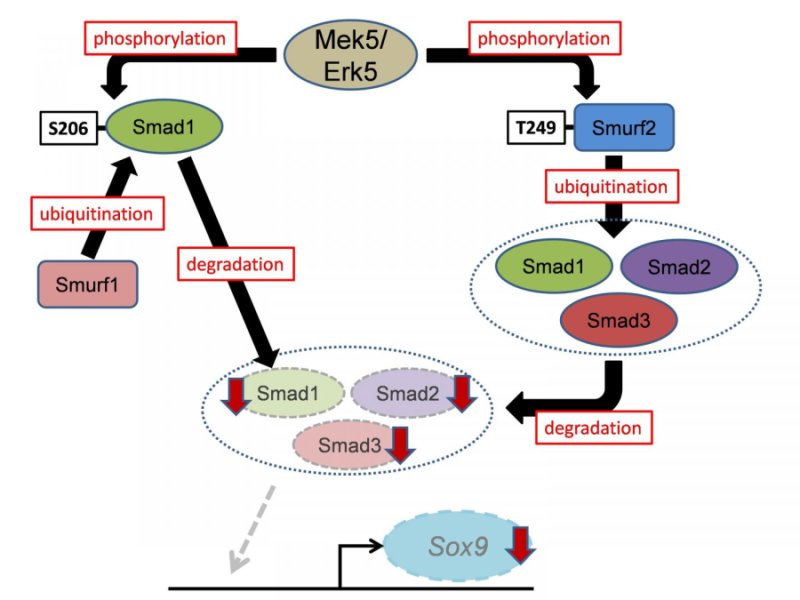
Schematic model of this study.


By using cell-specific mouse genetics approaches revealed that Erk5 plays a crucial role in skeletogenesis in vivo. Paired-related homeobox 1 (Prx1) is expressed in mesenchymal stem cells in the limb buds. Mesenchymal stem cell-specific Erk5 knockout embryos (Prx1-Cre;Erk5fl/fl embryos) displayed wider long bones and impaired mineralization of the metatarsal. In contrast, chondrocyte-specific Erk5 knockout embryos (Col2a1-Cre;Erk5fl/fl embryos) recapitulated only the wider long bone phenotype of Prx1-Cre;Erk5fl/fl embryos. Accordingly, the investigators revealed that Erk5 controls.
  1. Early chondrogenic differentiation of mesenchymal stem cells, including mesenchymal condensation, through its expression in skeletogenic progenitors
  2. Chondrogenic differentiation after the formation of mesenchymal condensations through its expression in chondrocytes.
Subsequent biochemical analyses found that Erk5 directly phosphorylates Smad1 at Ser206 in the linker region, which is known to trigger its proteasomal degradation in a Smad-specific E3 ubiquitin ligase 1 (Smurf1)-dependent manner. In addition, Erk5 directly phosphorylates Smurf2 at Thr249, leading to accelerated proteasomal degradation of Smad proteins (Smad1, 2 and 3).

The study demonstrated that Smads transcriptionally activate the expression in mesenchymal stem cells of sex-determining region within the Y-type high-mobility group box protein 9 (Sox9), which is the principal transcription factor involved in skeletogenesis. Moreover, using mouse genetic rescue experiments, the investigators revealed that Sox9 is a critical mediator of Erk5-dependent skeletogenesis.

 In conclusion, the Mek5/Erk5 pathway is critical for skeletogenesis in vivo through its expression in mesenchymal stem cells and modulation of Smad protein stability (Smad1, 2, and 3) via Smurf activity (Smurf1 and 2). These findings improve our understanding of the molecular mechanisms underlying skeletal development and spur the development of drugs targeting human cartilage diseases associated with abnormal chondrocyte differentiation and maturation. Moreover, since the Smurf2/Smads cascade is associated with other diseases, including cancer and ageing, the newly identified Mek5/Erk5/Smurf2/Smads/Sox9 cascade is a candidate target for developing drugs to treat a variety of human diseases.
 
We welcome researchers from different part of the to submit abstract on their latest research at our upcoming conference Cell Tissue Science 2019 which is mainly focuses on the complications the consequences of Stem CellRegenerative MedicineStem Cell TherapyCancer Cell Biology , Technical Advancements in cancer treatment and many more.We welcome you to the our upcoming conference “ 12th World Congress on Cell & Tissue Science” . For more info visit :Cell Tissue Science 2019

Friday, 5 October 2018

A grape constituent protects against cancer

Lung cancer is the deadliest form of cancer in the world, and 80% of death are related to smoking. In addition to tobacco control, effective chemoprevention strategies are therefore needed. A team of scientists from the University of Geneva (UNIGE), Switzerland, studied a well-known natural product, resveratrol, which is found in grapes and in red wine. While its chemopreventive properties against cancers affecting the digestive tract have been documented by previous studies, resveratrol has so far shown no effect on lung cancers. Thanks to nasal administration, the UNIGE team obtained very promising results in a study conducted in mice and described in the journal Scientific Reports.
"We tried to prevent lung cancer induced by a carcinogen found in cigarette smoke by using resveratrol, an already well-documented molecule, in a mouse model," explains Muriel Cuendet, Associate Professor, School of pharmaceutical sciences, UNIGE Faculty of Science.
This 26 week long study contained four groups of mice.
  • The first one, the control, received neither carcinogen nor resveratrol treatment.
  • The second received only the carcinogen.
  • The third received both the carcinogen and the treatment.
  • Fourth received only the treatment.
"We observed a 45% decrease in tumor load per mouse in the treated mice. They developed fewer tumors and of smaller size than untreated mice," says Muriel Cuendet. When comparing the two groups that were not exposed to carcinogen, 63% of the mice treated did not develop cancer, compared to only 12.5% of the untreated mice. "Resveratrol could therefore play a preventive role against lung cancer," she continues.
This formulation is applicable to humans
However, resveratrol does not seem suitable for preventing lung cancer: when ingested, it is metabolized and eliminated within minutes, and therefore does not have time to reach the lungs. "This is why our challenge was to find a formulation in which resveratrol could be solubilized in large quantities, even though it is poorly soluble in water, in order to allow nasal administration. This formulation, applicable to humans, allows the compound to reach the lungs," explains Aymeric Monteillier, scientist,School of pharmaceutical sciences of the UNIGE Faculty of Science.The resveratrol concentration obtained in the lungs after nasal administration of the formulation was 22 times higher than when taken orally. The chemoprevention mechanism is probably related to apoptosis, a process by which cells program their own death and from which cancer cells escape. The UNIGE research team will now focus on finding a biomarker that could contribute to the selection of people eligible for preventive treatment with resveratrol.
Towards a preventive treatment?
Resveratrol is an already well-known molecule, which is found in food supplements, meaning that no further toxicological study would be needed prior to commercialisation as a preventive treatment. "This discovery is unfortunately of little economic interest to pharmaceutical groups. The molecule is indeed simple and non-patentable and cancer prevention studies require a follow-up over many years," regrets Muriel Cuendet, without excluding the development of preventive treatment in humans..
 
We welcome researchers from different part of the to submit abstract on their latest research at our upcoming conference Cell Tissue Science 2019 which is mainly focuses on the complications the consequences of Stem CellRegenerative MedicineStem Cell TherapyCancer Cell Biology , Technical Advancements in cancer treatment and many more.We welcome you to the our upcoming conference “ 12th World Congress on Cell & Tissue Science” . For more info visit :Cell Tissue Science 2019

Monday, 24 September 2018

Human skeletal stem cells identified

Human skeletal stem cells that become bone, cartilage, or stroma cells have been isolated from fetal and adult bones. This is the first time that skeletal stem cells, which had been observed in rodent models, have been identified in humans. The researchers were also able to derive the skeletal stem cells from human induced pluripotent stem cells, opening up new therapeutic possibilities.
"Given the tremendous medical burden imposed by degenerative, neoplastic, post-traumatic, and post-surgical skeletal disorders, we believe that identifying this human skeletal stem cell and elucidating its lineage map will enable the molecular diagnosis and treatment of skeletal diseases," says Michael Longaker, Stanford University School of Medicine.
Skeletal tissues such as bone possess exceptional regenerative potential. Bone defects heal readily, and some vertebrates can regenerate entire portions of their limbs. But the regenerative capacities of skeletal tissues in other vertebrates are more restricted. For example, bones in mice and humans can recover from small- to moderate-sized defects, but adult cartilage tissues possess little to no regenerative ability. In addition, both mice and humans display severe age-related degeneration of skeletal tissues over time.
Skeletal dysfunction can lead to a broad spectrum of health conditions ranging from age-related diseases such as osteoporosis and osteoarthritis to non-healing skeletal injury, blood disorders, and even cancer. Despite its significant impact on health and disease, treatment options aimed at improving skeletal function are currently limited. One major hurdle is that stem cell regulation in the human skeletal system remains largely unexplored.
In the new study, Longaker and his collaborators addressed this gap in knowledge by identifying and characterizing human skeletal stem cells and downstream bone and cartilage progeny in a variety of tissues. These self-renewing and multipotent cells were present in both fetal and adult human bone marrow tissues and could be derived from induced pluripotent stem cells (iPSCs). By defining the relationships between human skeletal stem cells and downstream skeletal progenitors, the researchers created a detailed lineage map of stem-cell-mediated formation of skeletal tissues in humans.
Moreover, transcriptomic and epigenetic comparisons with mouse skeletal stem cells revealed evolutionarily conserved pathways regulating the stem-cell-mediated formation of skeletal tissues, as well as divergent molecular pathways that may regulate species-specific differences in bone development and skeletal structure.
"By comparing the molecular and functional differences in specific types of stem cells between different species of vertebrates, it may be possible to uncover convergent and divergent mechanisms that underlie tissue growth and regeneration and apply this understanding towards enhancing health and rejuvenation in humans," says Charles Chan, Stanford University School of Medicine.
 We encourage researchers all around the globe to submit abstract on their latest research at our upcoming conference Cell Tissue Science 2019 which is mainly focuses on the complications the consequences of Stem CellRegenerative MedicineStem Cell TherapyCancer Cell Biology , Technical Advancements in cancer treatment   and many more.We welcome you to the our upcoming conference “ 12th World Congress on Cell & Tissue Science” . For more info visit :Cell Tissue Science 2019